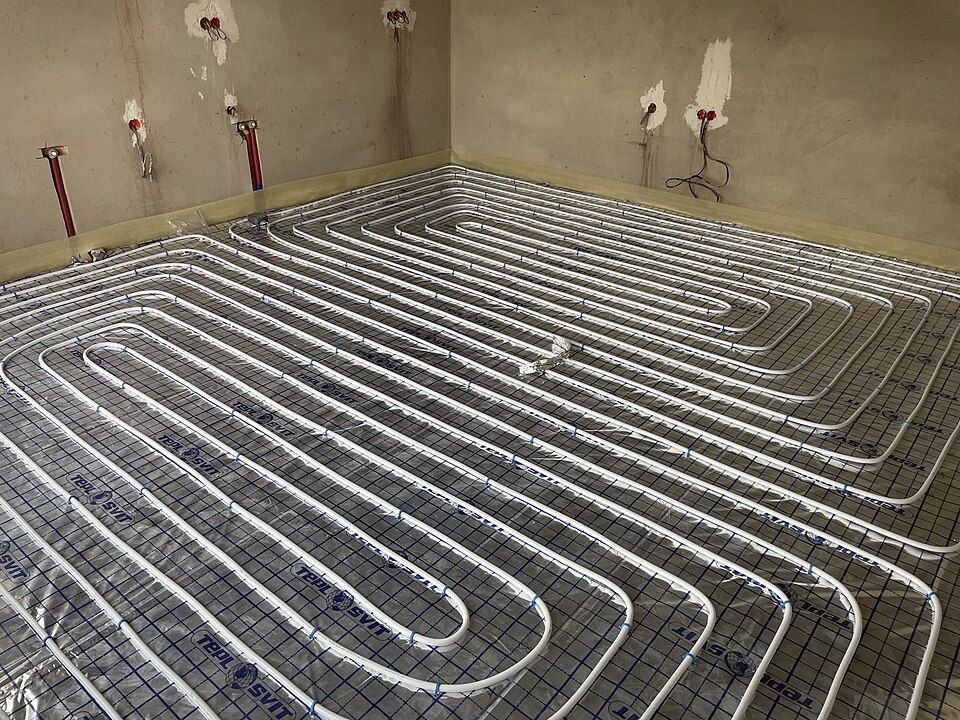
What is hydronic underfloor heating?
Hydronic underfloor heating is a heating (and cooling) system in which circuits of cross-linked polyethylene (PEX) pipe are installed within the floor, through which hot water circulates at low temperature (28–40 °C). Heat radiates uniformly upward from the floor.
| Feature | Hydronic Underfloor Heating | Electric Underfloor Heating |
|---|---|---|
| Energy source | Heat pump, boiler, solar thermal | Electric resistance (100%) |
| Efficiency | Very high (multiplied by COP) | Low (COP = 1) |
| Operating cost | Very low | High or very high |
| Pipe lifespan | 50+ years (manufacturer warranty) | 15–25 years |
Why must it be decided at the start of construction?
Underfloor heating is installed before the mortar screed is laid. Once the house is complete, adding it means: breaking up the entire floor, removing the flooring, raising the level by 6–12 cm, and replanning doors and thresholds. The cost is 3–5 times higher than in a new build.
Official Installers in Alt Empordà





How it is installed in new builds: the 7 phases
- Coordination with the architect: zones, circuits and plant room location.
- Floor thermal insulation: 3–6 cm XPS boards on the raw slab.
- PEX pipe laying: spirals at 10–20 cm spacing, independent circuits per zone.
- Pressure test: circuit pressurisation to detect leaks.
- Self-levelling mortar screed: 5–8 cm covering the pipes.
- Final floor covering: ceramic, porcelain, resin or low-thermal-resistance parquet.
- Connection to manifold and aerothermal unit: connection to Daikin, Panasonic, Vaillant or De Dietrich equipment.
Frequently asked questions
Is underfloor heating compatible with all floor coverings?
Ceramic, porcelain, marble, stone, polished concrete and epoxy resin are all compatible. Floating parquet designed for underfloor heating is also compatible.
How long does it take to heat the house?
Underfloor heating has high thermal mass: it takes 2–4 hours from cold. In primary homes, it is recommended to maintain a base temperature (18–19 °C) and programme the temperature rise a few hours in advance.